Home minister heads several groups of ministers, including the one to decide the revival package for Bharat Sanchar Nigam and Mahanagar Telephone Nigam. His ministry also takes decisive calls on national security in relation to telecom operations as well as equipment and technology used in the industry.

Airtel, Vodafone, BSNL increase subscriber share while Idea manages to retain

The uniform SUC, if implemented as per recommendations made by Telecom Regulatory Authority of India, will provide relief for mobile operators such as Airtel, Vodafone and Idea, but will increase rates for broadband wireless access spectrum holders like RJIL.

Despite the robust growth in this country, Apple's India share in its overall global sales remained modest -- constituting 1.5 per cent of its overall turnover of $389 billion in FY23.

Huawei willing to place its software code with government.

While existing players are expected to first drop prices, acquisition of smaller firms by larger ones is likely in future

The move comes against the backdrop of the US and some of its allies banning the purchase of Chinese telecom gear over security concerns and pressuring other countries to follow suit.

The companies have offered to pay upfront the principal amount due for licence fees and spectrum usage charges (SUCs) on the basis of adjusted gross revenue (AGR). This amount will not include the interest, the penalty, and the interest on the penalty.

The incumbent operators faced the onslaught of free offers and cheaper rates from Jio.
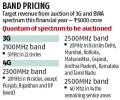
For 2100-MHz, 2300-MHz and 2500-MHz bands across circles; aim to offer these with 3G and 4G in February

Given the escalating cost of doing business, the revenue opportunity is decreasing and consolidation is an inevitable part of the industry.

India has average monthly spends of $4 per user; it is over $20 in other Asian markets

In return, BSNL should be allotted 1.2 MHz in the 1800-MHz band in each circle, subject to some conditions.

Telecom regulator TRAI on Tuesday released a detailed consultation paper to discuss threadbare the modalities for auction of spectrum across multiple bands, including pricing, quantum and other conditions -- preparing the groundwork for 5G auctions slated for next year. Trai's comprehensive consultation paper runs into 207 pages and throws up 74 questions for industry-wide discussion, touching on crucial aspects like valuation and reserve price of spectrum, including 5G, quantum of spectrum, block size, eligibility conditions for participation in auction, roll-out obligations, spectrum cap, and surrender of spectrum. Norms will also be worked out for new frequencies such as 526-698 MHz and millimetre band, that is 24.25 - 28.5 GHz, in addition to bands such as 700 MHz, 800 MHz, 900 MHz, 1800 MHz, 2100 MHz, 2300 MHz, 2500 MHz, 3300-3670 MHz.

The company has reportedly been in the process of shutting its CDMA business and shifting its subscribers to 2G, 3G and 4G networks.

A rare bonhomie among three private telecom companies in raising tariffs coming on the back of a bailout package by the government may have helped the telecom sector avert a crisis but the challenges haven't ceased to exist as the industry faces a cash-guzzling task of rolling out 5G networks in the coming months. The sector that provides direct and indirect employment to millions is projected to see Rs 1.3 lakh crore to Rs 2.3 lakh crore of investments in the coming years in creating robust infrastructure and building telecom and network products that have been incentivised by the government through PLI and other initiatives. After years of cut-throat competition and the apex court ruling on payment of past statutory dues left some players in the lurch, billionaire Sunil Mittal's Bharti Airtel and struggling Vodafone Idea almost in tandem raised tariffs, taking the plunge they had long been talking about.

Feedback from telecom members indicated a 10 per cent increase in traffic, but no fears of choked networks. Telcos currently use 65-70 per cent of the network capacity. In other words, they have enough additional capacity to handle the new pressure without clogging the system.

Analysts have pointed out that with the dues arising out of the SC judgment there could soon be only two private telcos in the country, and not three - Reliance Jio, Bharti Airtel and Vodafone Idea - as now.
Several factors have held India back. One is DoT policy somersaults and lack of clarity on whether to or not to ban Chinese gear makers.

Move comes in view of big debt overhang in two sectors; companies unwilling.
Move comes in view of big debt overhang in two sectors; companies unwilling.

The government will have to make substantial payments, as well as forego revenues in FY'23, if it wants to work on the survival of Vodafone Idea because it will have to extend the same incentives to the entire telecom sector. According to estimates, the industry has to spend around Rs 21,000-Rs 25,000 crore for spectrum which it bought on a deferred payment basis. Vodafone Idea has asked for a moratorium for another year (FY23). If granted, the government will have foregone the instalment payout for a third year in a row as it has already provided a moratorium for two years, giving telcos Rs 42,000 crore worth of relief.

DoT decides not to scrap dual-technology telecom licences

Among other segments, home broadband subscriptions have picked up and the virtual private network service, too, increased by around 15 per cent.
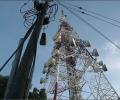
Telecom tower companies likely to invest around Rs 500 crore (Rs 50 billion) to enhance network.

Telecommunication companies buying airwaves in an Indian auction next month will pay 5 per cent of their revenue as an annual fee.

NavIC consists of a constellation of seven satellites and a network of ground stations and is touted to be more accurate than GPS.

With the Telecom Regulatory Authority of India (Trai) refusing to reserve 900-MHz spectrum for incumbent telcos, asking them to vacate the quantity held and win back through bidding, GSM operators, led by the Cellular Operators Association of India (COAI), have decided to propose a compromise formula.
It is learnt that the defence ministry is refusing to let go of its 100 MHz spectrum, which was allotted earlier. In that case, the department of telecommunications (DoT) will be left with only 175 MW of 5G spectrum of the total 300 MHz.

Released on Wednesday, the report shows that 81 per cent of men and 72 per cent of women in India owned a mobile phone as of 2022, translating to a gender gap of 11 per cent. The numbers drop steeply in terms of mobile internet adoption. While 52 per cent of Indian men use mobile internet, women are way behind, with only 31 per cent of them accessing mobile internet, the report pointed out.

Although the industry is disappointed with the government decision not to lower spectrum prices at a time telcos are saddled with over Rs 4-trillion debt and an estimated Rs 1.43-trillion licence fee dues, the DCC has relaxed the payment structure to offer some relief to the financially stressed sector.
The Cabinet approved giving Bharti Airtel, Vodafone Idea Ltd and Reliance Jio an option to avail of a two-year moratorium on payments they were supposed to make in yearly installments for the spectrum bought in auctions.

Trai calls both Jio and incumbents for a meeting to discuss the issue

Trai said the reports that compensation was not feasible were based on wrong inputs.
Analysts at rating agency ICRA say the debt level of the telecom companies is very high and the ecosystem for the premium band is not in place.
'While consumers have benefited tremendously from rock-bottom telecom tariffs, the telecom sector has been reeling under deep financial stress,' points out Rajan S Mathews, director general, Cellular Operators Association of India.

Apple is hoping to assemble in India 25 per cent of all iPhones produced globally to reduce its heavy dependence on China.
Need for much more investment; sector would like govt help

While the draft M&A policy for the telecom sector has been revised a few times over the past few months, DoT has not made any major changes to guidelines.

When on October 24, the Supreme Court, on a petition moved by the government, ordered payment of past dues according to its new definition of AGR, the country's second-biggest carrier Vodafone-Idea Ltd warned of shut down if no relief is given. The total dues for the industry ran into a whopping Rs 1.47 lakh crore. For an industry that has come from 7-8 operators to just three private players and state-owned fourth operator, the warning by Vodafone-Idea sounded like a death knell.
 © 2026 Rediff.com - Advertise with us - Disclaimer - Privacy Policy - Sitemap - Feedback - About us - Terms of use - Grievances